
More Models, One Question
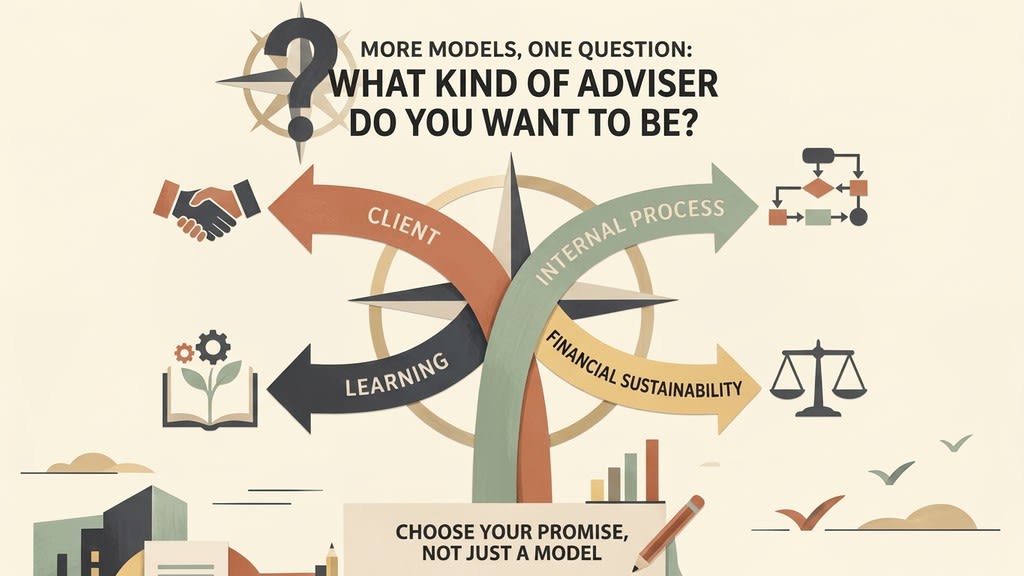
Advisers today have more business-model choices. That brings opportunity, but it can also blur the first question: what kind of adviser do you want to be? A simple quarterly Balanced Scorecard check can help you see whether your client relationships, follow‑ups, and financial sustainability match that answer.

Today, someone entering the financial advisory industry may have more business-model choices than before, with greater flexibility in the products and services they can offer their clients.
That creates more opportunity. But it also creates a more difficult question.
Having more choices about how to operate does not necessarily mean we know which business model is best suited to the kind of adviser we want to become.
The first question is not the model
The natural starting point is the model: independent, platform-based, captive, or hybrid. Each has strengths. But the model is just the structure. What matters is the advice you give and the relationship you build.
Model shapes practice; process reveals promise.
Start with the kind of adviser you want to be
Before choosing a model, write the answer in plain terms. Who is the client? What do they need from you that is not easy to get elsewhere? How often do you meet, and what happens in that meeting? What should be true after one year?
This is not a marketing exercise. It is a test. A good business model should make that answer easier to deliver, not harder. If a model requires you to promise more than you can keep, the model is the problem, not the market.
A simple quarterly check
Writing down what kind of adviser you want to be is not enough. You need to check whether your daily work actually matches it.
The Balanced Scorecard (BSC) is one way to do that. It is a simple framework that looks at four areas of your practice, not just revenue.
Balanced Scorecard (BSC)
A simple scorecard check that looks at four areas of your practice: client, internal process, learning, and financial sustainability.
| Perspective | Question it asks |
|---|---|
| Client | Do clients know what to expect, and do they get it? |
| Internal process | Is there a repeatable way to discover needs, deliver advice, and review it? |
| Learning | Does the adviser grow in skill and judgement over time? |
| Financial sustainability | Can the practice cover its costs and continue at this standard? |
You do not need to fill in a full scorecard. Once a quarter, sit down and ask yourself the four questions. Write down one gap and one action to fix it. That is it.
If clients know what to expect but your follow‑up process is weak, follow‑up depends on your memory. If you never check the learning question, you repeat the same year, year after year. The check is not about getting a perfect score. It is about seeing where the promise is real and where it is only on paper.
Process is discipline, not the answer
A process does not decide what kind of adviser you are. It protects that decision. With a clear rhythm, the promise becomes visible: a standard way to prepare for a meeting, a set of questions to ask, a date to review the plan. These are small things, but together let the client see and rely on the promise.
Without that rhythm, even a well‑chosen model can feel improvised. Clients may not name the gap, but they may feel it: advice that varies from meeting to meeting, follow‑ups that depend on the adviser’s memory.
More models mean more freedom, and freedom is a good thing. The discipline is to use that freedom deliberately: choose the kind of adviser you want to be, pick the model that fits it, and build a process that makes the promise visible.